Voyager 1 Reaches One Light-Day From Earth: What It Means, by the Numbers

At 5:16 a.m. EST on November 18, 2026, Voyager 1 becomes the first human-made object one light-day from Earth. We read NASA's own pages and put the distance, the timeline, the power problem and the numbers writers need in one place.
Last updated: November 16, 2026
A radio message sent to Voyager 1 this Wednesday will take a full day to arrive. The answer will take another day to come back. That's how far the little spacecraft launched in 1977 has traveled: on November 18, 2026, it becomes the first human-made object to sit one light-day from Earth.
If you write about science, education, technology, culture or simply good news, you'll want the basics fast and right: what a light-day is, how far that really is, what Voyager 1 is still doing out there, and how readers can join NASA's light-signal event. We read NASA's own mission pages, blog posts and media advisory, compared them with the main science coverage, and put the confirmed facts and the numbers in one place. Where sources disagree, we say so.
Key Facts
- When: Wednesday, November 18, 2026, at 5:16:07 a.m. EST (10:16:07 UTC) NASA.
- How far: one light-day is 16,094,799,096 miles (25,902,068,356 km), the distance light travels in 24 hours NASA. EarthSky puts it at 173.14 astronomical units EarthSky.
- How long it took: 49 years, two months and 11 days since launch on September 5, 1977 NASA.
- Talking to it: a command takes 24 hours to arrive, so a round trip takes two days NASA October 29 2026.
- Speed: about 38,000 mph (61,155 kph) NASA.
- Power: each Voyager loses about 4 watts a year as its plutonium fuel decays, and Voyager 1 has two science instruments still running NASA April 17 2026.
- Next: Voyager 2 reaches the same mark in November 2035 NASA.
What Is a Light-Day?
A light-day is a distance, not a length of time: it's how far light travels in 24 hours, about 16.1 billion miles (25.9 billion km). Light moves at about 186,000 miles per second, so even the fastest thing in the universe needs a whole day to cross it. When Voyager 1 is one light-day away, any signal between it and Earth takes 24 hours each way.
NASA stresses the point in its own explainer: the milestone "is about distance, not time" NASA. The same idea gives us the more familiar light-year, the distance light covers in a year, which NASA puts at about 5.88 trillion miles.
Here's how a light-day compares with other distances, using NASA's figures:
| Destination | Light travel time | Source |
|---|---|---|
| The Moon | 1.3 seconds | NASA |
| The Sun | 8 minutes 20 seconds | NASA |
| Mars | 3 to 22 minutes | NASA |
| Neptune | 4 hours 10 minutes | NASA |
| Voyager 1 (Nov 18) | 24 hours | NASA |
| Proxima Centauri | 4.24 years | NASA |
All figures come from NASA's light-day explainer. Mars has a range because the distance between Earth and Mars changes as both planets orbit the Sun.
Where Is Voyager 1 Now?
Voyager 1 is in interstellar space, the region between the stars, roughly 16 billion miles from Earth and heading out of the solar system at about 38,000 mph. It crossed the heliopause, the edge of the Sun's bubble of solar wind, in August 2012, and it's been the most distant human-made object since February 17, 1998, when it passed Pioneer 10 at 69.4 AU from the Sun NASA.
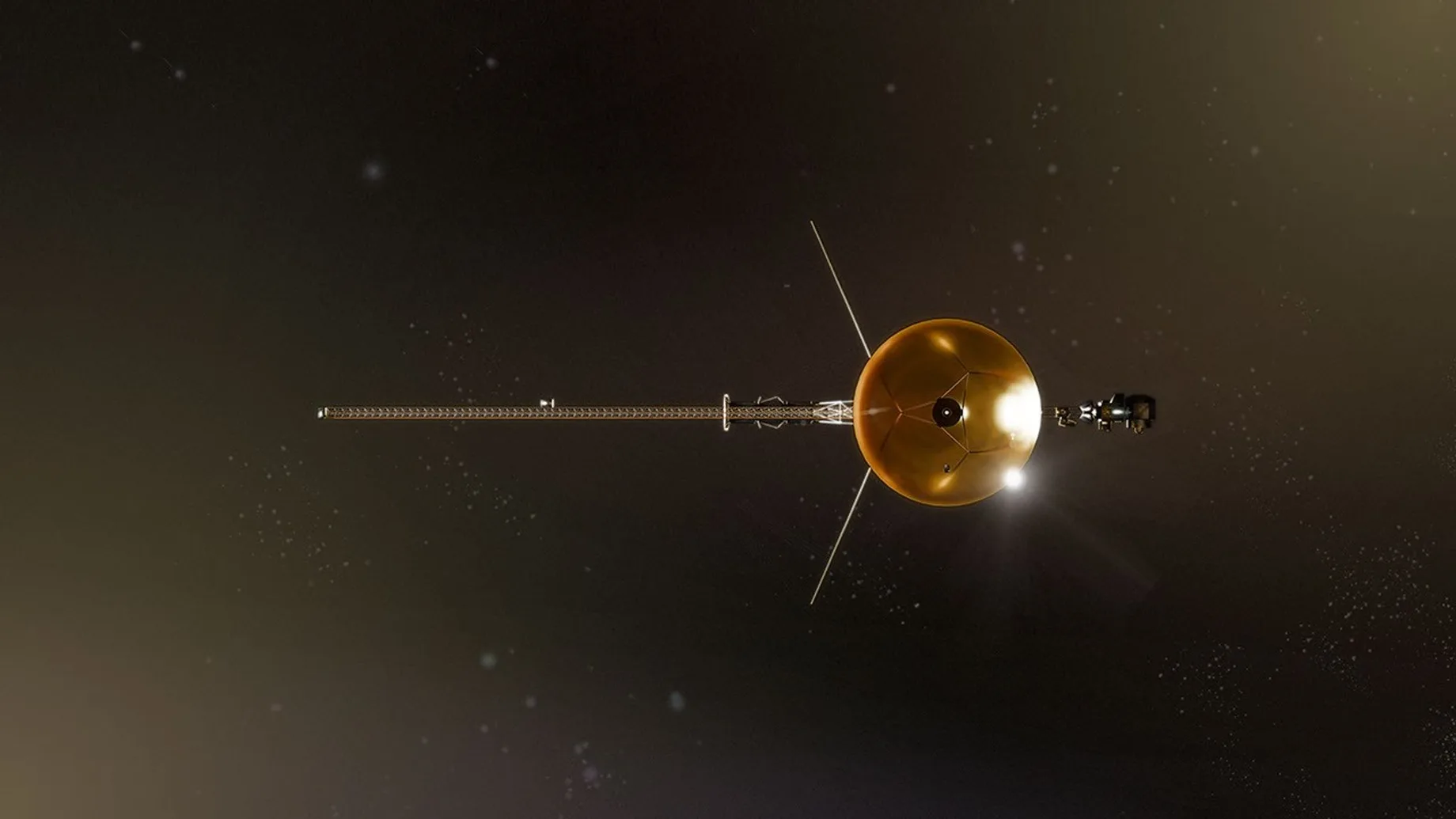
On Wednesday morning it reaches 16.094 billion miles (25.902 billion km) from Earth, NASA's own "where are they now" page says NASA. For a live position, NASA points readers to its Eyes on the Solar System viewer on that same page.
Nothing special happens to the spacecraft at that moment. NASA notes that Voyager 1 "will not detect any change in its environment" when it crosses the line NASA. The milestone matters to us on Earth: it's a round number that turns an abstract distance into something people can feel.
How Far Is One Light-Day, in Everyday Terms?
One light-day is about 67,000 times the distance from Earth to the Moon, or nearly six times the distance to Neptune. Those are our own conversions from NASA's figures, and so are the travel times below. They help readers picture a number that's otherwise too big to mean much.
| If you traveled at | Time to cover one light-day |
|---|---|
| Light speed | 24 hours |
| Voyager 1 (38,000 mph) | About 48 years |
| A jet airliner (550 mph) | About 3,300 years |
| A car on the highway (65 mph) | About 28,000 years |
How we worked it out: we divided NASA's light-day distance of 16,094,799,096 miles by each speed and converted hours to years. Voyager 1's speed is measured relative to the Sun, and its distance from Earth swings a little through the year as Earth circles the Sun, so its row is a rough figure. It does mean the spacecraft covers about 912,000 miles a day.
For scale on Voyager's own journey: when it took the famous Pale Blue Dot photo of Earth on February 14, 1990, it was about 40 AU from the Sun. One light-day is a little over four times farther out.
Why Does It Take Two Days to Talk to Voyager 1?
Radio signals travel at the speed of light, so at one light-day a command from Earth takes 24 hours to reach Voyager 1, and its reply takes another 24 hours to come back. Engineers send an instruction and wait two days to learn whether it worked. As Voyager project manager Suzanne Dodd put it, "you wait two days before you finally get a response" NASA.
That delay is already shaping the mission. On October 18 and 19, 2026, NASA's Deep Space Network failed to hear Voyager 1 on two scheduled contacts. The signal came back on October 20. The team found that one set of thrusters had gone offline and its backups had taken over, and that the spacecraft's fault protection, which puts it into a safe setup on its own, appears to have triggered. The cause is still under investigation NASA. "This is the first time we've seen the spacecraft do something like this," said mission manager Kareem Badaruddin.
Is Voyager 1 Still Working?
Yes. Voyager 1 still sends data home, but it's running on very little power. It launched with 10 science instruments, and after its April 17, 2026 shutdown of the Low-energy Charged Particles experiment, two remain on: one that measures plasma waves and one that measures magnetic fields NASA.
The power comes from radioisotope thermoelectric generators, which turn heat from decaying plutonium into electricity. Each spacecraft loses about 4 watts a year. To slow the shutdowns, engineers ran a fix nicknamed the "Big Bang" in early September 2026: they switched off three devices that keep Voyager 1 warm and turned on three lower-power alternatives at the same time. NASA says that without it, another instrument could have had to go as early as summer 2027 NASA.
One correction worth knowing: NASA's main Voyager 1 page still lists four working instruments. The newer April 2026 mission blog says two. We go with the newer post, since it describes the shutdowns that happened since.
How long will it last? NASA hasn't set an end date. Its October update says the team is preparing for more surprises through summer 2027. Science News reported in October that the power is expected to run out in 10 to 15 years Science News, but we didn't find that range on NASA's own pages, so treat it as an estimate.
What Has Voyager 1 Found Out There?
Voyager 1 is still sending back measurements from beyond the Sun's bubble. Science News sums up what it has seen beyond the heliopause: slower particles, cooler gas, a weaker magnetic field, about half as much dust as inside the Sun's bubble, and four unexplained jumps in magnetic field strength and particle density, the last in mid-2020 Science News.
Researchers still debate the shape of the Sun's bubble, Science News reports. Princeton's Jamie Rankin, Voyager's deputy project scientist, told Science News that out there, "for the most part, it's been very quiet and very consistent."
A Short Voyager 1 Timeline
| Date | Milestone |
|---|---|
| Sept 5, 1977 | Launch from Cape Canaveral |
| Mar 5, 1979 | Closest approach to Jupiter |
| Nov 12, 1980 | Closest approach to Saturn |
| Feb 14, 1990 | Pale Blue Dot photo of Earth |
| Feb 17, 1998 | Becomes the most distant human-made object |
| Aug 2012 | Enters interstellar space |
| Apr 17, 2026 | Another instrument switched off to save power |
| Nov 18, 2026 | One light-day from Earth |
Dates come from NASA's Voyager 1 mission page, its mission blog and NASA's Pale Blue Dot material.
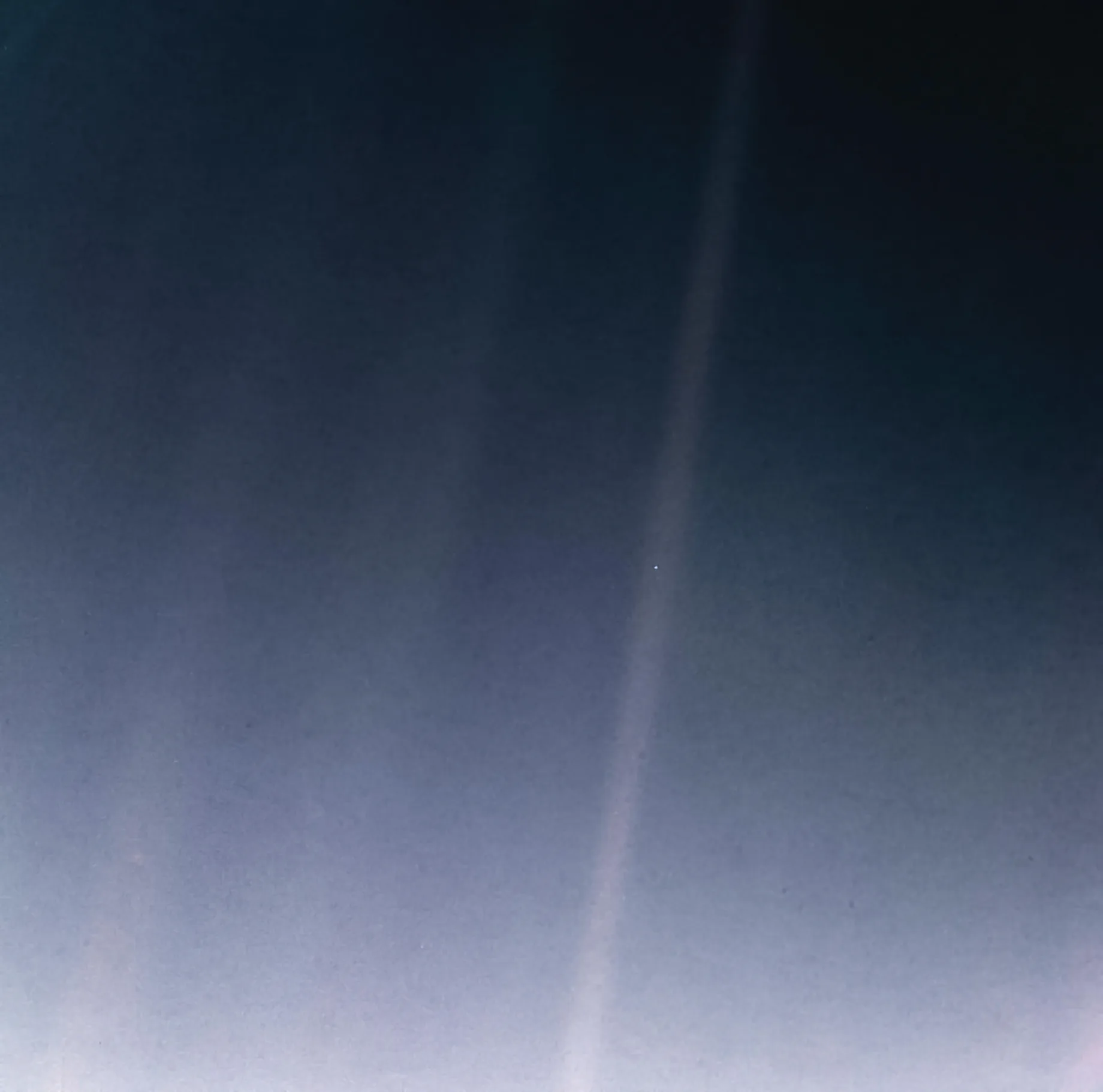
The Pale Blue Dot, shown here in NASA's 2020 reprocessed version, was taken from about 3.7 billion miles away NASA Photojournal. Voyager 1 is now more than four times as far.
What Is on the Golden Record?
Each Voyager carries a 12-inch gold-plated copper record meant for anyone who might find it. A committee chaired by Carl Sagan picked the contents: 115 images, greetings in 55 languages, natural sounds like surf, wind, thunder, birds and whales, and 90 minutes of music from around the world. It also holds printed messages from President Jimmy Carter and U.N. Secretary-General Kurt Waldheim NASA.
Nobody should expect a reply soon. Voyager 1 is heading toward a star called AC +79 3888, also known as Gliese 445, and will pass within about 1.7 light-years of it in about 40,000 years, NASA says NASA. Science News gives about 44,000 years for the same encounter, so expect slightly different numbers in different articles.
How Can You Join NASA's Shine Bright Event?
NASA is asking people everywhere to flash a light at the sky after sunset on Tuesday, November 17, the evening before the milestone. The easiest way is NASA's web flasher at go.nasa.gov/vgr: open it on a phone or tablet, point the screen up, and it blinks Voyager's call sign, VGR, in Morse code NASA.

You can also do it by hand with a flashlight, bike light or lantern. V is three short flashes and one long, G is two long and one short, and R is short, long, short. NASA suggests repeating it for about a minute and sharing photos or video tagged @NASA. The phone in your pocket is the tool for this one, and with about 6.3 billion people now online, as we covered in how many people use the internet, plenty of the planet could join in.
On Thursday, November 19, at 12 p.m. EST, NASA's Jet Propulsion Laboratory hosts a live discussion with the Voyager team on nasa.gov/live, with a preview of a NASA+ documentary planned for the mission's 50th anniversary in 2027.
What to Watch Next
- The November 19 briefing: the team may share Voyager 1's latest health and power numbers.
- The thruster question: NASA hasn't yet said what caused the October thruster switch.
- More shutdowns: with about 4 watts lost each year, each new power decision is news.
- 2027: the 50th anniversary of both launches, in August and September.
- November 2035: Voyager 2 reaches its own light-day, if it's still talking.
Where Our Facts Come From
We used NASA's own pages as the main source for every number: the light-day explainer, the Voyager 1 mission page, the "where are they now" page, the Golden Record page, the April 17 and October 29, 2026 mission blog posts, and the November 10 media advisory. We checked the time of the milestone against EarthSky and Science News. Some outlets print 5:18 a.m.; NASA says 5:16:07 a.m. EST, and that's the time we use. The everyday travel times are our own arithmetic from NASA's distance.
How to cite: if you use a number or table from this page, please credit BestWebsiteTemplate.com and link to this page. For a writing angle on how long your own explainer should be, see our study on how long a blog post should be.